
Buying guides
Coloured pencils: dry colour, water-soluble ranges and replacement
Compare coloured pencil types, wet-use instructions, individual colour replacement and useful set sizes for the drawings you actually make.
Published Information checked
Coloured pencils can share a familiar appearance while behaving differently on paper. Some ranges are intended mainly for dry work, some can be moved with water, and others have specific instructions for permanence after wet use. Choose the range for the technique first, then compare the size of the set.
Distinguish the intended techniques
Read the exact range name and instructions. A pencil described as water-soluble can be worked with a wet brush, but that label does not establish every later behaviour. If you want to layer wet media over a drawing, check the maker’s information and try the combination on an offcut. Do not infer permanence simply because the surface feels dry.
Build a useful colour selection
The number of pencils matters less than the colours available for your subjects. A portrait, botanical study and graphic illustration can favour different selections. Look for a colour chart and label your own swatches on the paper you use. Repeatedly layering the same few colours may teach you more than owning a large assortment whose differences are hard to identify.
Look beyond the tin
Check whether individual colours are available in the same range and whether the pencil dimensions suit your sharpener or case. A large presentation tin can be attractive but awkward to carry. If the pencils are a gift for someone who already draws, ask about their current range so that replacements and additions can work together.
Keep a working colour inventory
Before adding a second pencil set, make a list of the exact range and colours already owned. Compare that list with the proposed set and identify genuinely useful additions. A larger tin can include many duplicates, which may be welcome replacements or simply unused stock. For recurring work, record the colour numbers used in a drawing alongside its paper and technique. That makes a future replacement more precise and prevents an online colour image from becoming the only reference for a shade needed to continue an existing project.
A worked shopping example
An illustrator wants coloured details that can later be softened with a brush. A large dry-pencil set is not automatically the right answer. Compare suitable water-soluble ranges, test the paper and decide which colours are used most often. If a later waterproof layer is part of the project, verify the exact product instructions and make a sample before working on the final drawing.
Details to compare side by side
| Detail | What to record | Why it changes the choice |
|---|---|---|
| Pencil type | Dry, water-soluble or another stated formulation | Changes the techniques the range is designed to support |
| Colour selection | Named colours and replacement options | Helps match the set to recurring subjects |
| Practical fit | Pencil dimensions and case format | Affects sharpening, storage and use away from a desk |
Before placing the order
- Record the full range name and wet-use instructions; similar brand packaging can cover different pencil types.
- Check individual colour replacement and the colour chart before selecting a large set.
- Include suitable paper and sharpening arrangements, and test mixed-media combinations on a spare piece first.
Making a project involves a chain of choices. The material, tool and instructions should work together, and the quantity should cover the actual project rather than the smallest advertised pack. Keep an offcut, swatch or label when possible so that you can identify what worked when ordering again. A small trial is often more informative than a larger assortment.
Are all water-soluble pencils the same after drying?
Do not assume that they are. The exact formulation and maker’s instructions matter, particularly when another wet layer will be added. Keep a labelled sample of the range on your intended paper and test the full sequence. That is more informative than treating a broad product category as a guarantee of identical behaviour.
Find relevant specialist shops
Use the profiles for Jackson’s Art, Cass Art, London Graphic Centre to reach their official websites and check the exact listing. These are relevant places to explore, rather than a claim that every shop has the same item in stock. Browse the wider arts & crafts directory for more specialists.
Examples to inspect
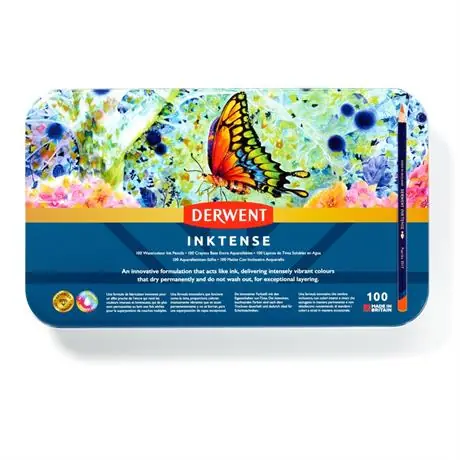
For a specific example of the details discussed here, explore Derwent Inktense — 100 Pencils Tin. These product notes identify the model or format and link to official listings; they are examples to compare, rather than a claim that one option suits every buyer.
Sources and checks
Products mentioned in this guide
PRODUCT
Derwent Inktense — 100 Pencils Tin
A100-colour Inktense pencil set in a tin. Compare the exact range, colour count and package rather than treating every water-soluble pencil set as equivalent.
Retailer profiles: Pullingers
View product detailsContinue reading
Buying guides
Buying acrylic paint: heavy body, fluid colour and useful sets
Compare acrylic paint consistency, container size and colour selection for brush painting, broad coverage and mixed-media projects.
Read the guide
Buying guides
Watercolour pans or tubes: build a useful first palette
Compare watercolour pans and tubes by working method, palette space, colour selection and replacement options before building a first set.
Read the guideBuying guides
Choosing a sketchbook: paper, binding and working position
Compare sketchbook paper, binding, usable size and portability for drawing at a desk, outdoors or while travelling.
Read the guideEXPLORE THE DIRECTORY
Related shop profiles

Jackson’s Art
Jackson’s Art offers a deep range of painting, drawing and printmaking materials, including its own-brand supplies. It suits artists comparing precise pigments, papers and tools rather than choosing mainly by the size of a starter set.

Cass Art
Cass Art focuses on painting, drawing and other fine-art materials, with an online shop and physical stores. Compare the exact medium, paper and product size, then check the appropriate online or in-store purchase conditions.
London Graphic Centre
London Graphic Centre brings artist materials, design supplies and distinctive stationery together with its Covent Garden shop. It suits mixed creative baskets, from drawing and presentation materials to pens, notebooks and practical studio essentials.