
Buying guides
Watercolour pans or tubes: build a useful first palette
Compare watercolour pans and tubes by working method, palette space, colour selection and replacement options before building a first set.
Published Information checked
A useful first watercolour palette gives you colours you can learn and replace. The largest box is not necessarily the easiest place to start. Decide whether you mainly paint at a desk, carry materials outside or need to prepare larger mixes, then compare how the paint format supports that routine.
Compare the working setup
Pans keep colours in separate compartments and can suit a compact travelling arrangement. Tubes allow paint to be dispensed into a mixing area. Neither format tells you everything about the individual colour, so read the range, colour names and maker’s information rather than comparing only the number of pieces. A set containing brushes and a box may have fewer actual paint colours than its headline count suggests.
Look at the colours individually
Write down the colours already used by a course or reference book, if you are following one. Check whether a set supplies those colours or a reasonable starting selection. Several similar convenience mixtures may be less useful for learning than a smaller palette whose colours you can identify. Keep a labelled swatch sheet so you can see the dried result on your own paper.
Check how replacement will work
Find out whether the colours are sold individually in the same range. A convenient boxed assortment can become frustrating if a frequently used colour cannot be replaced in the size or format you need. Check the physical fit of replacement pans and the dimensions of a travel box before assuming that every small paint container will fit every palette.
Separate colours from repeated supplies
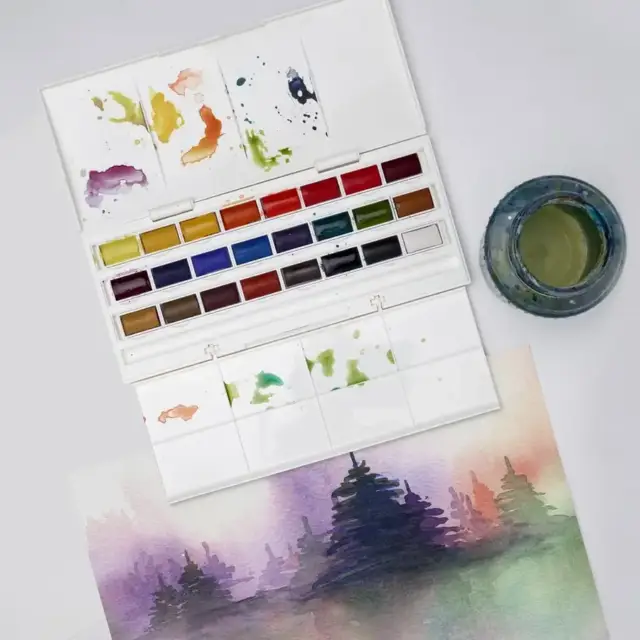
A palette with twenty containers does not necessarily contain twenty different colours. A set may deliberately include extra quantities of frequently used colours or additional equipment. Read the named contents and make two lists: distinct colours and quantities supplied. Repeated white or another useful colour can be practical, but it should be understood as extra material rather than extra variety. Apply the same method when comparing a pocket box with a studio set, because the intended working arrangement may explain the contents better than the advertised piece count.
A worked shopping example
A learner attending a weekly class needs a manageable kit and the colours named by the tutor. Compare a compact pan set with a few individual tubes, including the mixing palette and brush already owned. If the class involves larger washes, ask the tutor about suitable quantities. Buy enough for the actual exercises and add further colours after discovering what the initial selection cannot do.
Details to compare side by side
| Detail | What to record | Why it changes the choice |
|---|---|---|
| Format | Pan or tube and stated quantity | Changes how paint is prepared and carried |
| Selection | Named colours in the set | Shows whether the palette fits your class or intended subjects |
| Replacement | Individual colour and physical size | Helps avoid replacing an entire set when one colour runs out |
Before placing the order
- Count paint colours separately from brushes, palettes, sponges and other accessories included in a set.
- Check the exact range and colour names, since similar packaging can cover different paint formulations.
- Confirm replacement availability and box compatibility before buying spare pans or a large refill selection.
Making a project involves a chain of choices. The material, tool and instructions should work together, and the quantity should cover the actual project rather than the smallest advertised pack. Keep an offcut, swatch or label when possible so that you can identify what worked when ordering again. A small trial is often more informative than a larger assortment.
Do I need many colours to start?
You need a selection that supports your intended exercises and a way to understand its mixtures. A large assortment can be enjoyable, but it is harder to learn if the colours overlap and their names are not clear. Start with the requirements of the course or project, make swatches and expand when you can describe the missing colour or mixing behaviour.
Find relevant specialist shops
Use the profiles for Jackson’s Art, Cass Art, GreatArt to reach their official websites and check the exact listing. These are relevant places to explore, rather than a claim that every shop has the same item in stock. Browse the wider arts & crafts directory for more specialists.
Sources and checks
Continue reading
Buying guides
Buying acrylic paint: heavy body, fluid colour and useful sets
Compare acrylic paint consistency, container size and colour selection for brush painting, broad coverage and mixed-media projects.
Read the guideBuying guides
Coloured pencils: dry colour, water-soluble ranges and replacement
Compare coloured pencil types, wet-use instructions, individual colour replacement and useful set sizes for the drawings you actually make.
Read the guide
Buying guides
Choosing watercolour paper: fibre, texture and weight
Choose watercolour paper by fibre, texture, sheet size and painting method, with a practical comparison of pads, blocks and loose sheets.
Read the guideEXPLORE THE DIRECTORY
Related shop profiles

Jackson’s Art
Jackson’s Art offers a deep range of painting, drawing and printmaking materials, including its own-brand supplies. It suits artists comparing precise pigments, papers and tools rather than choosing mainly by the size of a starter set.

Cass Art
Cass Art focuses on painting, drawing and other fine-art materials, with an online shop and physical stores. Compare the exact medium, paper and product size, then check the appropriate online or in-store purchase conditions.

GreatArt
GreatArt offers a broad fine-art catalogue and a London art store. It is useful for comparing specialist materials and larger studio items, with warehouse delivery and shop purchases treated as distinct shopping routes.